Pages

Showing posts with label LESSON PLAN. Show all posts

Reflection Art

Today, we took some time out of our regularly scheduled plan to do a little art. I had a lesson planned on coordinate graphing where students would plot points to make their initials and complete various transformations. While that lesson will still happen (probably on Monday), we did some reflection art instead.

Students started by folding their papers in half (hot dog style).

We then wrote our name with the fold at the bottom. It was amazing how much trouble students had just with writing their name. With that taking a while, I knew I was in for it when we began cutting.

I instructed to start by cutting around the tops of their names.

We then took to the bottom, making sure to leave some pieces of the fold in tact.

Students started to open their reflections, but weren't happy with the designs, so they then went to making more cuts, cutting out any circles or open spaces that they could. We ended up with a beautiful wall of reflection art and some great conversations about geometry, reflections, and symmetry.


After my students saw me taking pictures of their artwork, a few of them decided to jump in for a shot!


Here is the final wall with the artwork of my class as well as Mrs. Trousdale's classes!


(When I have time I will try to add step-by-step pictures.)

Anyway, do you ever deviate from your planned lesson and end up with something wonderful? Don't you love when that happens?! Please share!


Scoot in Action

Recently, I posted this picture and my excitement about trying out the game of "Scoot" in my classroom. I'm a week late with blogging about this activity in my class, but better late than never!


Generally with the game or learning structure of "Scoot," you place a different problem/task card on each desk. Students have a set amount of time at that desk, and then they move on to the next desk/task card and begin work on the new problem. Students use a recording sheet to record their work, and then the problems are reviewed at the end of the exercise.

I love the idea, except for the fact that I don't want students to have to wait to the end to know if their work is correct. This prompted me to make color coded answer keys to go with my task cards. 


I put the desks in groups of four. Student rotated around the desk four times to complete the problems. I was surprised at how many grumbles I got about getting up and moving from one desk to another, but when they heard the music at transition time, the grumbles decreased. After the group finished, they checked their work on the corresponding answer key.


After they checked their work, they moved to a new group of four task cards. I allowed students to change groups if they wanted at this point, which meant they could work with a new group of students if they chose to. They just had to got to a new set of cards so that they were working on a new set of task cards.

Sorry for the blurry picture.
Since the solutions were completed worked out on the answer key, students were able to see where they went wrong on problems. This also gave them the opportunity to have discussions about the problems, since they all worked them individually. Students had great discussion around the answer keys. 

I printed the problems on 2" x 4" Avery address labels and then affixed them to colored index cards. It made the assembly of color coded cards really easy. Here's a link to the files used to make this Rational Number Operations Scoot that we used in my 8th grade math class.

I am so enjoying trying new things in class lately. On next week's list is the Origami Frog Olympics to review 2D geometry and probability. Here's a little peek at what's to come...


Easiest BINGO Ever!

So glad I ran across Sarah @ Everybody is a Genius last week! As I stalked one of my new favorite math teacher blogs, I found the easiest way to do classroom bingo ever! All she suggested is to print a worksheet, any worksheet. Kuta Software is a great resource, but it can seriously be any worksheet and any skill.

Students are given a blank Bingo square with a list of answer choices at the bottom. They use those answer choices to make their own bingo card.
I then used a random number generator to choose a problem from 1 to 24. That number corresponded with the problem we worked from the worksheet. Students were excited to be so close to winning Bingo that they asked for another question even as time was running short.

I promise this is the easiest way ever to transform a worksheet into interactive practice of a math skill. You only need a worksheet of 24 problems with the answer key and to create a bingo square. Thanks so much to Sarah @ Everybody is a Genius for sharing! Go check out her blog for great ideas and lots of interactive notebooking resources.

I Hate When this Happens...

...when I start thinking about how to do things better next year. I still have about 12 weeks left in this school year and I'm already thinking about Day 1 for next year...ughh!!! But, I think all good teachers probably do this!

Tonight, I've been perusing my twitter PLN, browsing old hashtags I used to frequent and came across @shareski and a tweet that really intrigued me...
This tweet led me to another and eventually to a blog post about assessment by Bill Ferriter...more specifically having students assess their own learning.
Something I've implemented lately is a unit test reflection. My students go back through their math test identifying if they missed a problem due to a simple mistake (which they can fix on their own) or a lack of knowledge (and need more instruction). I then set up structured tutorials based around the concepts students have identified that they need more instruction for. In addition to identifying areas for improvement, students also identify their successes. You can download a copy of the document I've been using here.

Bill Ferriter has a very similar  form he uses after tests which can be found on his blog here. I love his form and will probably change a few things about mine based on the sample Dean has provided.

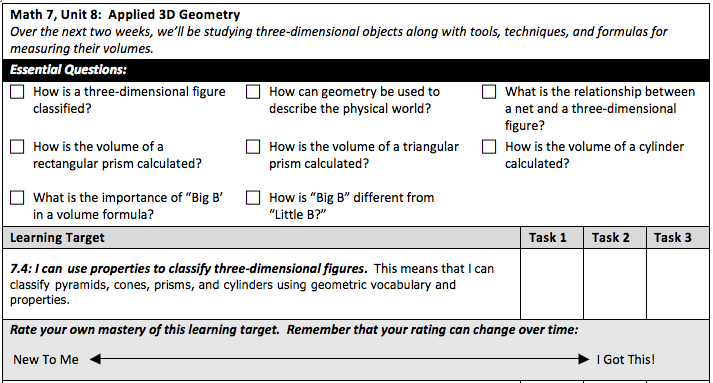
This is a great reactive approach, but I've been trying to be more proactive in my approach to supporting students. Well, Bill has an answer for that too! I love his Unit Overview Sheet which can be found here! His students refer to this page at the beginning of most lessons to to focus on the objective for the day and then again at the end of a lesson to evaluate where they are in terms of mastery of the objective. He encourages students to update their position of mastery as they learn more and become more confident with the material.

I can't wait to try it out myself in my math class. I just spent an hour developing one for an upcoming 7th grade math unit on 3D geometry. Here's a little preview...
And you can download the full document here. Now that it's made, Bill has left me some insight to making it work!
You should definitely head over to Bill's Blog to check out his thoughts.

First Day Revisited


Wow! What a week?! I took care of all my teachers and didn't get much time to take care of myself this week. I finally sat down and really planned out my first day of school. I had a plan that I blogged about here, but that has changed a bit due to some required info that must be disseminated in each period. It's the school plan for addressing the student handbook, because we all know that it doesn't actually get read. So, each period is assigned a different part of the handbook to review with students. I thought having pages 8-11 would be no big deal, but it's actually quite a bit of information. I don't want to just read it or have my students read it, so of course, I had to come up with something a bit more interesting. Thanks, Trista for mentioning a jigsaw! The beginning of the lesson was modeled after a post by Daniel Schneider. His first day plan is so thorough and well thought-out. Okay, so here's the plan:

  • Line up by birthdays
  • Answer math question correctly to grab a partner and pick your seat. (integer questions since that will be our first lesson)
  • Seats assigned, now let's practice how you'll enter the classroom.
  • Warm-up, page 11 of handbook - highlight any phrase you think is important & underline any phrase you have a question about
  • Handbook Jigsaw - each group assigned a page to highlight & underline as modeled in the warm-up
  • "Pay attention, there's going to be a quiz afterwards."
  • Students share highlights and underlines for whole class
  • "My Life in Numbers" Quiz, followed by Prezi with answers.
  • "Student Life in Numbers" - 5 numbers important to students and why. 1-2 paragraphs. HW if not completed in class.
  • Procedure for exiting classroom.


The "Student Life in Numbers" will flow into the next day as their paper blog post. Day 2 plan:

  • Warm-up - Highlight & underline syllabus
  • Syllabus acknowledgment placed in HW folder and due tomorrow
  • "What is a Blog?" discussion & video
  • Complete paper blog post using "Student Life in Numbers" assignment
  • Discuss & show examples of good commenting vs. bad commenting
  • Post-it note commenting activity
  • Lockdown Procedures (I know that doesn't flow, but required by school)


So, that's a rough outline. Here's a copy of my SMART Notebook files (and pdf) for both days...
Day 1 - Mrs. Howard.notebook
Download File

Day 1 - Mrs. Howard.pdf
Download File

Day 2 - Mrs. Howard.notebook
Download File

Day 2 - Mrs. Howard.pdf
Download File

I feel good about it. Afraid I may have too much on day one, so it may change within the next 24 hours, but I feel good about the plan. I really hope to have a good experience with the paper blogging. It feels a bit rushed, but I have to start curriculum on day three. I'll be sure to share the results!

Calendar Math

Picture
I have always liked the ideo of calendar math and the way it is used in elementary classes. Many of the ideas that I've found for calendar math have been targeted towards elementary math skills.

On Pinterest, I ran across a link for Calendar Math for the Upper Gradesby Nasreen Wahid and I am so glad I did! he file is two pages, but I plan to shrink it to fit one page. It reviews concepts such as word form, expanded form, basic operations, fraction-decimal-percent conversions, prime/composite, greater than/less than, factoring, central tendency, area, and perimeter! And there is no need to create numbers for the problems because they all come from the date and the day in school!It could be great as a daily or weekly warm-up activity! 

Head over to TeachersPayTeachers for this great file, currently on sale for $2!

First Day of School Plan for 2012


I always seem to end one school year thinking about what I'm going to do differently the following school year. During the 2011-2012 school year, my partner in crime, Trista stumbled upon the idea of the flipped classroom concept and we ran with it! We had great successes and great opportunities for improvement as well. For those of you who don't know what the flipped classroom is, you can find lots of information here. In a nutshell, a flipped classroom teaching technique for math is one where the primary purpose of the out-of-class time is for the student to learn the content through instructional videos and other resources, and the primary purpose of the classroom time is for students to solve problems alone or collaboratively, share projects and artifacts, and to receive personalized coaching from the professional teacher.

Okay, so, at first, all of my planning for next school year was in reference to my flipped classroom. Well, God has blessed me with a new position at a new school, where I'll only be teaching one class of students and the rest of my day is more of the math department chair and instructional coach. I will be responsible for providing weekly job-embedded professional development, follow-up with teachers to help execute strategies taught in professional development, and formal evaluations of teachers. The official title is Math Master Teacher, and the position is funded through the Teacher Advancement Program.

So, at my new school, I don't know the student population as well, but I know that the demographics are almost the polar opposite of my last school. Now, I do not assume that means my students will not have access to internet outside of school, but I know there will be many more without access than the school I am moving from where the flipped classroom worked so well. Anyway, I had contingencies for students without interent access i.e. dvd with videos for the unit, transferring videos to flash drives and iPods, etc. Okay... I'm rambling, basically I'm still working on videos, but I'm not going in day one assuming that I'll be using a flipped classroom model, but will survey my students first.

So...now to the point and the title of this post, I have developed a plan for my first day of school, which I am extremely excited about. (My 'flipping' partner, Trista helped be refine the plan while we were in Chicago for the Flipped Classroom Conference.) I am so tired of going through all my procedures and rules on day one. They mean nothing if they are not being practiced, so instead, I will review and teach procedures as they come up in our class time. So, here's the run-down of day one:

  1. Procedure for entering the classroom
  2. My Life in Numbers Quiz
  3. Student Life in Numbers
  4. Begin Paper Blogging Activity
  5. Procedure for leaving the classroom

That's it! Woohoo!!!! Okay, so #1 and #5 don't really need explanation. Here's more about #2, #3, and #4.

My Life in Numbers Quiz - This idea comes from Mrs. C by the Numbers. Basically, this teacher starts day one by telling students to clear their desk for a quiz. It's 10 questions and it's matching, so hopefully, students will do well. Quizzes are passed out face down and students are not to turn them over unitl instructed to do so. Turns out the quiz is all numbers related to an event of fact about the teacher's life. It's basically a a get to know your teacher activity. Here is my 'My Life in Numbers Quiz' so far. A few items may change. I plan to have a Prezi with pictures to go through the correct answers for 'grading.'

Student Life in Numbers - So, I will then ask students for 3-5 numbers that describe themselves and why. This has two purposes: to learn a little about my students & to get them thinking for the next activity...paper blogging.

Paper Blogging - This idea comes from Notes from McTeach, a blog I stumbled upon when doing my research when considering blogging my math classroom. I haven't worked out all the details, but in short this activity is to teach what a blog is and to teach good commenting. Students will choose a topic they are passionate about i.e. family, favorite food, sports, etc. I hope that their 'life in numbers' will give them some ideas. Students will write and decorate a paper blog post about that topic. After the paper blogs are written and decorated, students will then practice commenting with post-it notes. This will hopefully occur during day 2 of class. We will discuss the attributes of good blog comments. I will hang the paper blogs around the classroom. Students will read a blog thoroughly, and then leave a comment with a post-it note. Students will then rotate to another blog and leave a new comment or comment on the previous student's comment. At the end of the activity, students will get their paper blog back and get a chance to read any comments and respond with a post-it note if they wish.
I hope this activity will pique an interest in blogging and get us started with blogging in the classroom.
Are you looking for more middle school math teachers'
plans for the first day/week of school? If so, check out #msSunFun...
#msSunFun