Pages

Showing posts with label MATH GAME. Show all posts

Scoot in Action

Recently, I posted this picture and my excitement about trying out the game of "Scoot" in my classroom. I'm a week late with blogging about this activity in my class, but better late than never!


Generally with the game or learning structure of "Scoot," you place a different problem/task card on each desk. Students have a set amount of time at that desk, and then they move on to the next desk/task card and begin work on the new problem. Students use a recording sheet to record their work, and then the problems are reviewed at the end of the exercise.

I love the idea, except for the fact that I don't want students to have to wait to the end to know if their work is correct. This prompted me to make color coded answer keys to go with my task cards. 


I put the desks in groups of four. Student rotated around the desk four times to complete the problems. I was surprised at how many grumbles I got about getting up and moving from one desk to another, but when they heard the music at transition time, the grumbles decreased. After the group finished, they checked their work on the corresponding answer key.


After they checked their work, they moved to a new group of four task cards. I allowed students to change groups if they wanted at this point, which meant they could work with a new group of students if they chose to. They just had to got to a new set of cards so that they were working on a new set of task cards.

Sorry for the blurry picture.
Since the solutions were completed worked out on the answer key, students were able to see where they went wrong on problems. This also gave them the opportunity to have discussions about the problems, since they all worked them individually. Students had great discussion around the answer keys. 

I printed the problems on 2" x 4" Avery address labels and then affixed them to colored index cards. It made the assembly of color coded cards really easy. Here's a link to the files used to make this Rational Number Operations Scoot that we used in my 8th grade math class.

I am so enjoying trying new things in class lately. On next week's list is the Origami Frog Olympics to review 2D geometry and probability. Here's a little peek at what's to come...


Easiest BINGO Ever!

So glad I ran across Sarah @ Everybody is a Genius last week! As I stalked one of my new favorite math teacher blogs, I found the easiest way to do classroom bingo ever! All she suggested is to print a worksheet, any worksheet. Kuta Software is a great resource, but it can seriously be any worksheet and any skill.

Students are given a blank Bingo square with a list of answer choices at the bottom. They use those answer choices to make their own bingo card.
I then used a random number generator to choose a problem from 1 to 24. That number corresponded with the problem we worked from the worksheet. Students were excited to be so close to winning Bingo that they asked for another question even as time was running short.

I promise this is the easiest way ever to transform a worksheet into interactive practice of a math skill. You only need a worksheet of 24 problems with the answer key and to create a bingo square. Thanks so much to Sarah @ Everybody is a Genius for sharing! Go check out her blog for great ideas and lots of interactive notebooking resources.

Connect Four: Pythagorean Style

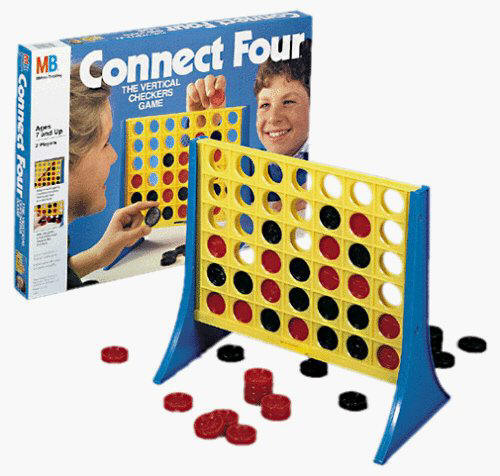
As a kid, my brother and I played Connect Four frequently. I even remember having the travel version that we would take on trips.

Today's activity reminded me of those childhood days as I had to explain to some students how to play Connect Four. About half of my class was familiar with the game...boy, how times have changed!

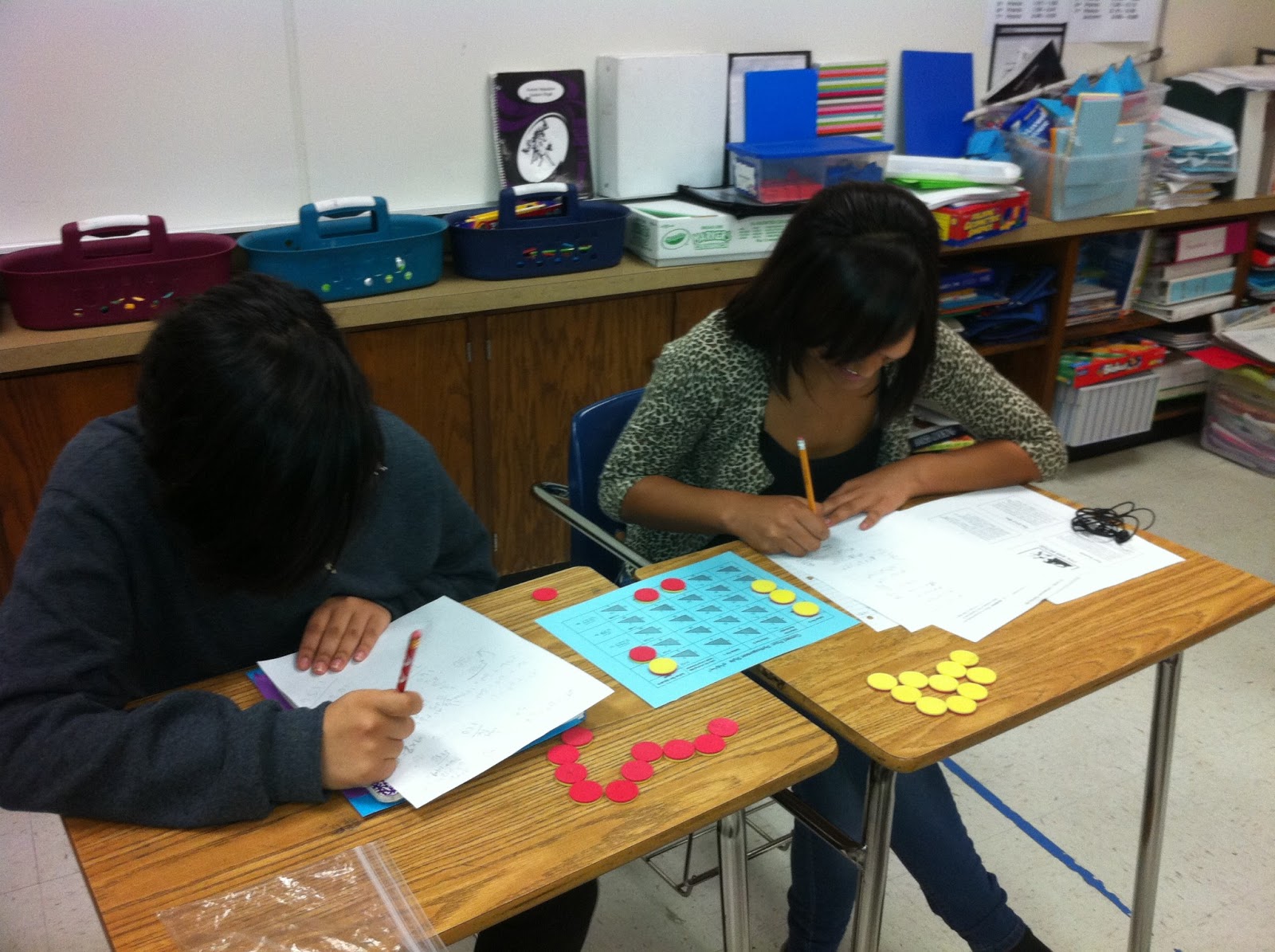
Students received a game board and colored counters. Students paired up, picked their color and I flipped a counter to designate who would go first. Students then took turns choosing a problem that they both worked. If the student who picked the problem got it correct, they got to place their counter on the board. If they got it incorrect, the other student could steal with a correct answer. Students alternated choosing problems based on strategy for getting a Connect 4.


My students did a great job working today and enjoyed the Connect Four game format.The game board was made by a colleague. There are a few problems that were repetitive, meaning students could look at another problem on the board and use it to get the answer, but other than that, I loved it. I mean, we do want our kids to be resourceful, right?! No point in doing extra work when the answer is sitting in front of you. Anyway, here is a copy of the game board. It can easily be edited for various concepts. Enjoy!
   

Hot Seat Jeopardy

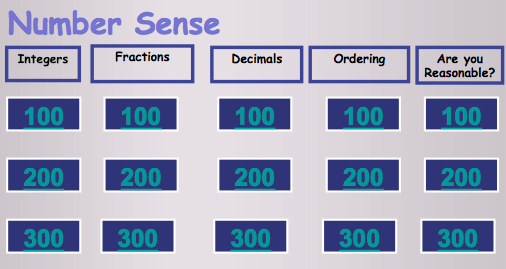
I'm not a huge fan of playing PowerPoint Jeopardy games in my class. I think this is mostly because of lack of management of the game on my part, and in turn, lack of participation by my students. Recently the planned lesson by a member of my team was another Jeopardy Review. This was the best Jeopardy Review we've done in my class because of the structure that was added.

Students were placed into teams of 3-4 students and sat in a line (one behind the other). The person at the front of the row was designated as being in the hot seat! Each student had a recording sheet which matched the Jeopardy categories and point values to show their work for each problem.


As we selected a problem, all students worked the problem on their recording sheet and as they finished could pass their paper up to the team member in the hot seat to offer their solution and help. As the team member in the hot seat decided on a solution (only with the work of his teammates, but without talking), he then passed their papers back. I then took answers for the team only from the hot seat.

After we finished the problem, students rotated up a seat, putting a new team member in the hot seat! The front student went to the back of the team line.

I really enjoyed this structure and so did the kids. All students were working. Accountability came from me taking up individual recording sheets and using their work to help their team! I think I will continue to do any Jeopardy lesson this way and not dread them so much now!